Faster Turnarounds Start with Better Access
Civil Construction projects are under constant pressure to deliver faster turnarounds. Tight programmes, changing site conditions and demanding deadlines mean every hour matters.
But speeding up a project shouldn’t mean taking shortcuts with safety.
The answer isn’t simply to work faster. It’s to make safe access faster and easier to implement in the first place.
When workers can move safely between levels, cross site obstacles and work at height without waiting, the whole project can keep moving.
1. Plan access before it becomes a problem
One of the simplest ways to improve site efficiency is to consider access during the planning stage rather than reacting to it once work has started.
Ask:
- How will workers safely move between different levels?
- Where will temporary access routes need to cross excavations or other obstacles?
- Where will edge protection be required as the project progresses?
- Will access requirements change as the structure develops?
- Can the chosen system be installed and adapted quickly?
Good access planning reduces the need for last-minute solutions and helps prevent teams from creating their own workarounds.
SafeSmart’s range is designed around this principle, with solutions that can be installed, adjusted and adapted easily as site requirements change.
2. Use adjustable access when levels are constantly changing
On construction sites, finished floor levels and working areas rarely stay the same throughout a project.
Building fixed access for every change can mean repeated installation, dismantling and rebuilding, all of which takes time.
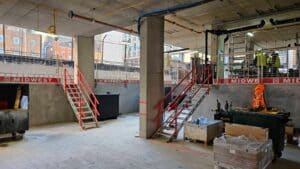
AdjustaStairs provide a more flexible approach.
The result: safer movement between levels without constantly rebuilding the access route.
Avoid the shortcut
Never use materials such as loose timber, pallets, scaffold components or other unsuitable items to create makeshift steps or ramps.
If the level changes, provide an access system designed for the application rather than asking workers to improvise.
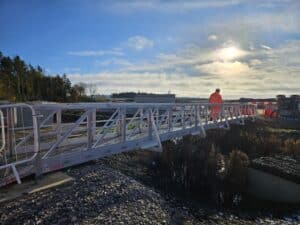
3. Don’t let excavations become an access bottleneck
Excavations, trenches and other temporary openings can quickly become obstacles to productivity.
If workers need to repeatedly walk around an excavation because there is no suitable crossing point, valuable time is lost and people may eventually be tempted to find their own way across.
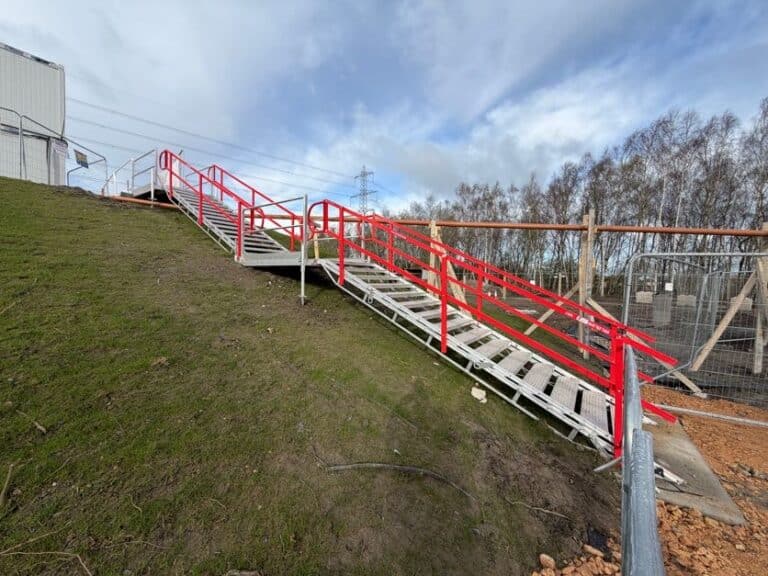
Instead of creating improvised crossings, a properly designed modular bridge provides a defined route for pedestrians to safely move across obstacles.
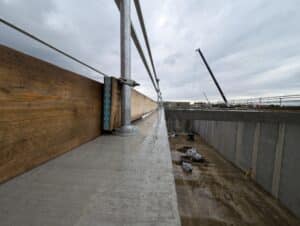
4. Choose edge protection that doesn’t slow the project down
Edge protection is essential on many sites, but traditional installation methods can sometimes introduce additional work, time, and risk.
Drilling holes, cleaning up dust and debris, installing fixings and subsequently repairing surfaces can all add labour and time to a project, alongside the added risks of silica dust inhalation, heavy vibrations, and loud noise.
That’s where Non-Drill Edge Protection can make a difference.
That means:
Less drilling. Less disruption. Less installation time.
And importantly, removing a time-consuming installation step can make it easier to get protection in place before work starts at the edge.
5. Don’t let speed create new safety problems
Trying to recover lost time can sometimes create a dangerous cycle:
Delay → pressure → shortcut → incident → even more delay.
The best way to maintain momentum is to remove the reasons people feel they need to take shortcuts.
Simple site practices can make a significant difference:
Keep access routes clear
Materials, tools and waste should not be allowed to obstruct designated walkways, stairs or platforms.
Inspect temporary access regularly
Site conditions change. Access equipment that was suitable yesterday may no longer be suitable after excavation, structural or sequencing changes.
Make access part of the initial planning
Don’t wait until workers need to reach an area before deciding how they’ll get there.
Use the right equipment for the application
A ladder, scaffold component or improvised platform may appear to solve a problem quickly, but it may introduce additional risks and create more work later.
Review access as the project changes
Temporary works should evolve with the construction programme. If the building changes, the access strategy may need to adapt with it.
Faster doesn’t have to mean riskier
Construction efficiency isn’t about asking workers to move faster.
It’s about removing the obstacles that stop them from working efficiently in the first place.
AdjustaStairs can provide adaptable access between changing levels. AdaptaSpan can create defined routes across site obstacles. Non-Drill Edge Protection can help get edge protection installed without the additional work and risk associated with drilling.
Together, these types of solutions demonstrate an important principle:
When safe access is easier to install, easier to adapt and easier to use, safety becomes part of productivity — not a barrier to it.
Build efficiency into your access strategy
Before your next project starts, ask:
Where could better access save us time and remove the opportunity for someone to take a shortcut?
SafeSmart’s range of temporary access, edge protection and height access solutions is designed to help construction teams create safer, more efficient ways of working.